COVID-19 modelling in Illinois

Early in March 2020, our team led by Professor Jaline Gerardin joined the Illinois COVID-19 modelling task force, which works with the Illinois Governor’s Office and Illinois Department of Health (IDPH). Together with three other modelling groups in Illinois, we provided COVID case and hospital predictions that were updated weekly. With our model outputs we aimed to provide additional early warning signs to prevent exceeding hospital and ICU bed availability. Our model outputs also supported selecting and interpreting epidemic indicators, planning for hospital overflow needs, quantifying the impact of delayed test turnaround time on overall death counts, designing sentinel surveillance systems, and understanding how good contact tracing needs to be to contain spread.

The model and analysis script can be found in the public GitHub repository here!

Related publications: Runge et al medRXiv, 2021

School Malaria Parasitaemia Survey

Here comes some text describing my experience of the SMPS survey more in detail

Volunteer at MESA's correspondent program

“This volunteering opportunity at MESA caught my immediate attention and excitement. As a young researcher it is of great importance to seek out such opportunities, which will facilitate networking, recognition, and skill development . My PhD research focuses on the modeling of malaria interventions to support strategic planning” (Motivation statement in 2018)

Participated conferences:

Find more about MESA’s correspondence program in this interview: The MESA Correspondents Program behind the scenes

Modelling larviciding deployment strategies

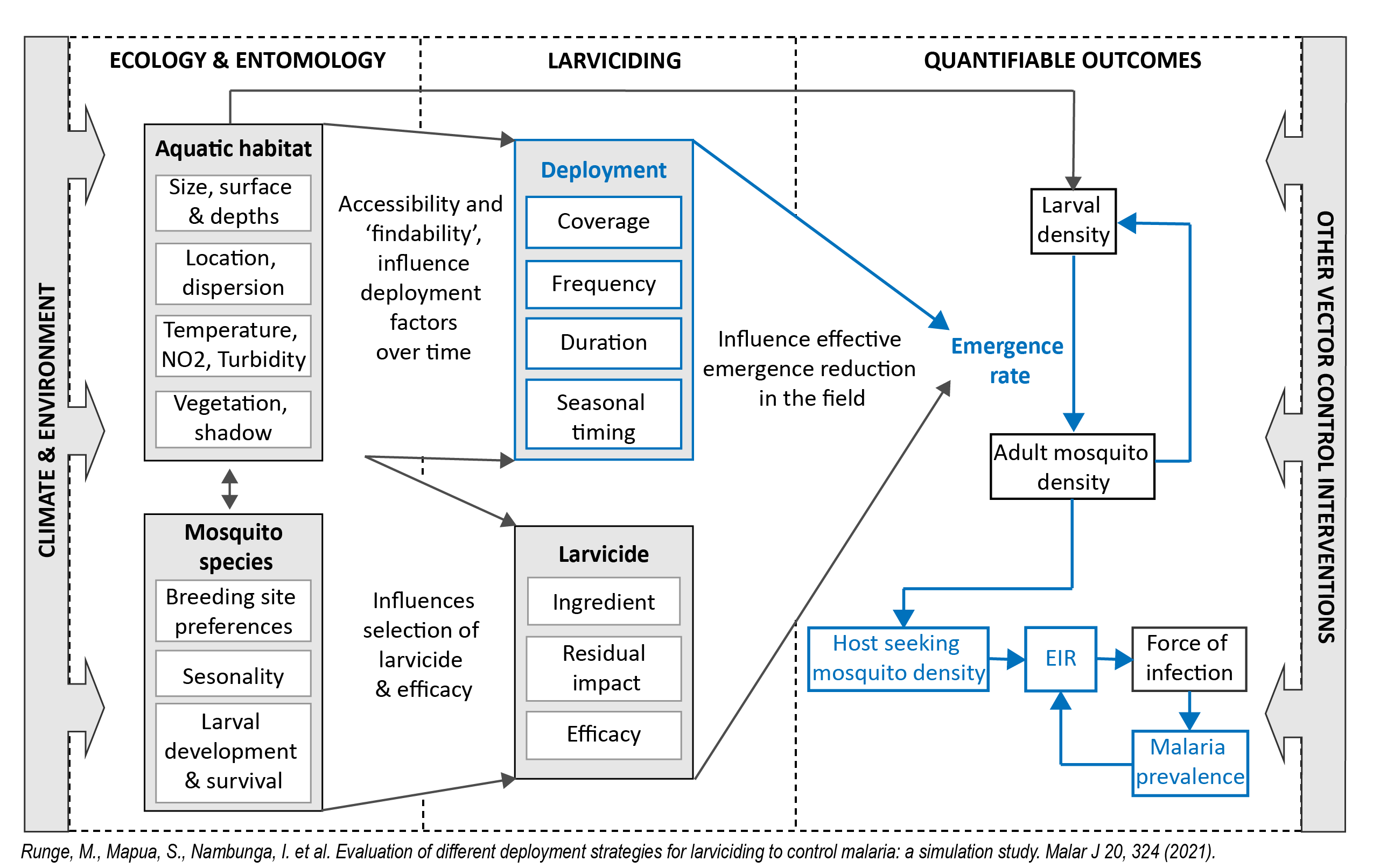
The simulation modeling of larviciding in Tanzania conducted for my main PhD research led to the question on how to model larviciding effectiveness? What coverage and what effect sizes to assume? The literature search revealed high variation of the impact of the intervention, depending on what larvicides were used and how these were deployed, as well as what outcome measures and timeframes were looked at. The indepth literature search and explorative models of larviciding impact for different deployment assumptions became its own project. In this context, a short research stay at the Ifakara Health Institute, Kilombero Tanzania, for almost three months, allowed me to learn more about Anopheles breeding sites. The work led to two poster presentations () and one publication.

Evaluation of different deployment strategies for larviciding to control malaria: a simulation study Modelling the impact of different larviciding deployment regimens to inform strategic planning Modelling the role of An.funestus in a setting where insecticide treated nets are already widely used but malaria transmission persists


School Malaria Parasitaemia Survey


In 2015 I was working on the School Malaria Parasitaemia Survey (SMPS) in Tanzania as part of my Master degree studies at the Swiss Tropical and Public Health Institute. Data was collected in three phases from primary school pupils in all regions of the mainland. I was involved in the study planning, supervised data collection in one region, and lead the data entry and cleaning of the second phase (9 regions). For the field work I visited the schools in each of the district of Arusha region to supervise the data collection process together with a local supervision team. I ran multilevel mixed effects logistic regression models to asses the influencing factor of malaria and of bednet use among primary pupils. In addition maps were produced for the visualisation of the malaria prevalence among district councils. The statistical analysis was performed using Stata and maps generated in QGIS.

Nationwide school malaria parasitaemia survey in public primary schools, the United Republic of Tanzania

School Malaria Parasitaemia Survey poster access pdf here


Additional documents: After my master studies I worked as a research assistant on the merging of all three study phases and data cleaning which led to the development of the data management SOP’s below.

Multi-Malaria-Modeling framework (MultiMalModPy)

In 2015 I was working on the School Malaria Parasitaemia Survey (SMPS) in Tanzania as part of my Master degree studies at the Swiss Tropical and Public Health Institute. Data was collected in three phases from primary school pupils in all regions of the mainland. I was involved in the study planning, supervised data collection in one region, and lead the data entry and cleaning of the second phase (9 regions). For the field work I visited the schools in each of the district of Arusha region to supervise the data collection process together with a local supervision team. I ran multilevel mixed effects logistic regression models to asses the influencing factor of malaria and of bednet use among primary pupils. In addition maps were produced for the visualisation of the malaria prevalence among district councils. The statistical analysis was performed using Stata and maps generated in QGIS.

Nationwide school malaria parasitaemia survey in public primary schools, the United Republic of Tanzania

School Malaria Parasitaemia Survey poster access pdf here


Additional documents: After my master studies I worked as a research assistant on the merging of all three study phases and data cleaning which led to the development of the data management SOP’s below.

School Malaria Parasitaemia Survey

In 2015 I was working on the School Malaria Parasitaemia Survey (SMPS) in Tanzania as part of my Master degree studies at the Swiss Tropical and Public Health Institute. Data was collected in three phases from primary school pupils in all regions of the mainland. I was involved in the study planning, supervised data collection in one region, and lead the data entry and cleaning of the second phase (9 regions). For the field work I visited the schools in each of the district of Arusha region to supervise the data collection process together with a local supervision team. I ran multilevel mixed effects logistic regression models to asses the influencing factor of malaria and of bednet use among primary pupils. In addition maps were produced for the visualisation of the malaria prevalence among district councils. The statistical analysis was performed using Stata and maps generated in QGIS.

Nationwide school malaria parasitaemia survey in public primary schools, the United Republic of Tanzania

School Malaria Parasitaemia Survey poster access pdf here


Additional documents: After my master studies I worked as a research assistant on the merging of all three study phases and data cleaning which led to the development of the data management SOP’s below.